

Did you know that stepping into your own private sanctuary four to seven times a week could reduce your risk of cardiovascular mortality by 50%? This data from JAMA Internal Medicine highlights why so many people are now prioritizing a personal wellness retreat. However, as you compare an infrared vs traditional sauna for your home, the technical jargon about near versus far wavelengths or the fear of a massive electricity bill can quickly dampen your excitement. You want a great space for relaxing and connecting, not a research project that adds more stress.
You deserve a space that offers total relaxation without the maintenance headaches or complex installation requirements. This guide is your definitive roadmap to understanding how different heat delivery systems impact your biology and your floor plan. You'll learn the key differences between infrared and traditional heat so you can build a relaxing retreat in your own home. We'll explore everything from the easy installation of hybrid models like the Rövia Aurora 3-Person Indoor Hybrid Sauna to the latest 2026 safety standards, ensuring your new centerpiece is as reliable as it is luxurious.
Key Takeaways
- Understand the core physics of heat delivery, distinguishing between the intense convection of traditional air heating and the targeted radiant warmth of infrared waves.
- Discover how traditional dry steam sessions can mimic the heart-health benefits of moderate exercise through high-temperature cardiovascular stimulation.
- Compare the benefits of an infrared vs traditional sauna to see how deep-tissue light penetration can accelerate muscle recovery during longer, more breathable sessions.
- Identify whether your lifestyle demands a sensory-focused wellness ritual or a high-performance tactical tool for daily physical maintenance.
- Explore the advantages of hybrid technology that combines both heating methods, giving you the flexibility to customize your home retreat for any mood or recovery need.
Understanding the Core Mechanism: How Infrared and Traditional Saunas Differ
To build a legendary home retreat, you first need to understand the physics behind the steam. The debate over an infrared vs traditional sauna isn't just about personal preference; it's about how your body interacts with heat. One method wraps you in a blanket of scorching air, while the other uses light to warm you from within. Choosing the right one determines whether your recovery space feels like a high-intensity ritual or a gentle, deep-tissue therapy session.
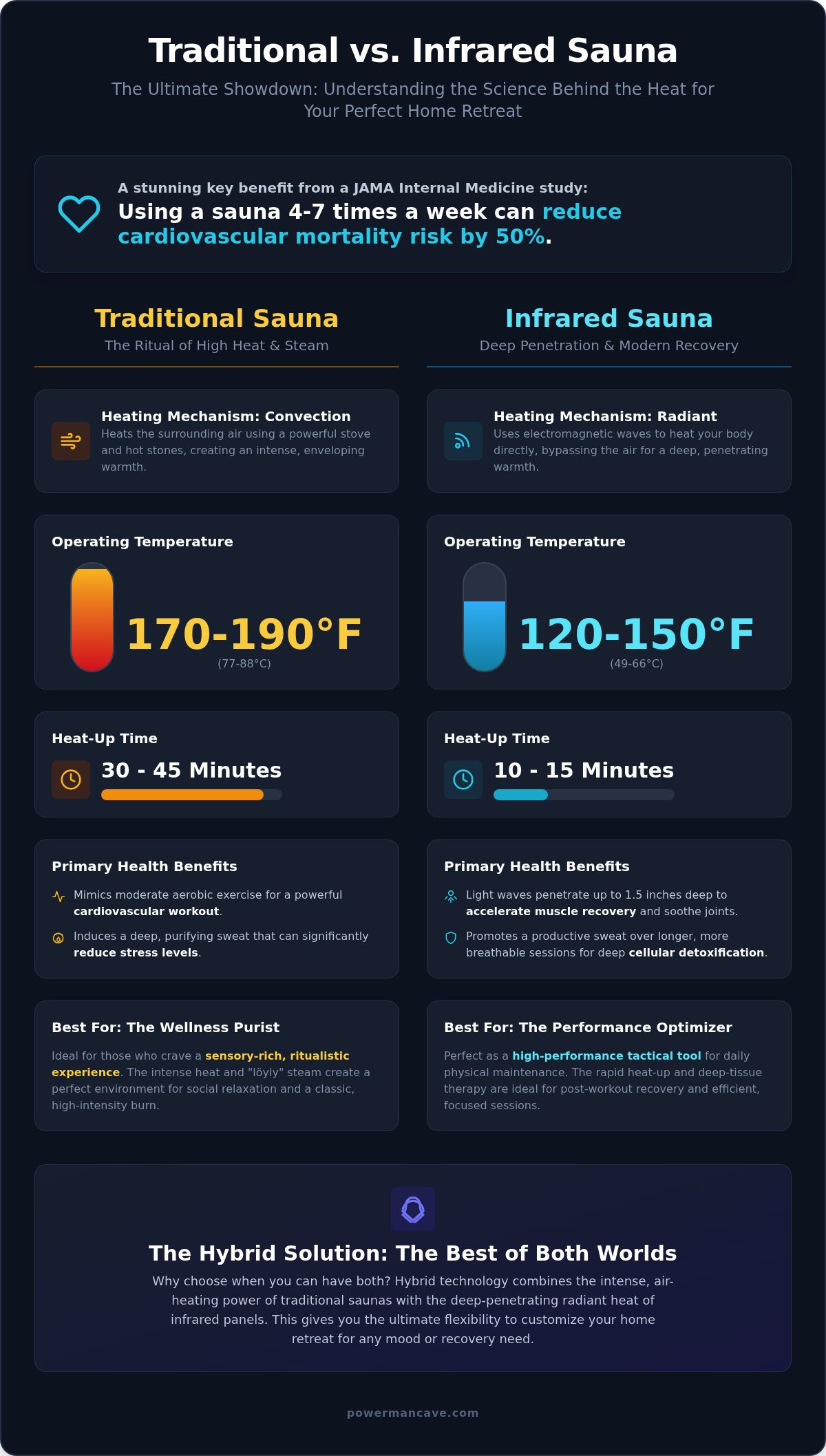
Traditional saunas operate on the principle of convection. They use a powerful heater to warm a stack of stones, which then radiates heat into the room. Ambient temperatures in these environments typically range from 170°F to 190°F. In contrast, infrared saunas stay much cooler, usually hovering between 120°F and 150°F. This temperature gap changes everything about your experience, from how long you can stay inside to how much electricity you'll pull from the grid.
Convection Heat: The Traditional Finnish Method
The hallmark of the traditional experience is the "löyly." This is the cloud of steam created when you pour water over hot stones. It provides a sensory-rich environment filled with the scent of hot wood and the hiss of evaporating water. Because the air is so hot, your body works overtime to cool itself down, leading to an intense cardiovascular workout. If you're weighing the benefits of hybrid sauna vs traditional models, you'll find that traditional heat is unmatched for that classic, high-intensity burn that many purists crave.
Radiant Heat: The Science of Infrared Light
Infrared technology bypasses the air entirely. It uses electromagnetic waves to heat your body directly. These waves penetrate up to 1.5 inches beneath the skin, reaching deep into muscle tissue and joints. This radiant heat is often categorized into three types. Near-infrared focuses on skin health; mid-infrared aids in circulation; and far-infrared provides the deepest penetration for detoxification. Because the air remains breathable and dry, it's an ideal choice for users who find high humidity or extreme temperatures suffocating.
Logistics also play a role in your daily routine. A traditional heater requires 30 to 45 minutes to reach the necessary heat for a proper session. Infrared panels are much faster, often reaching their target temperature in 10 to 15 minutes. If you want to go from a finished workout to a recovery session in record time, the speed of infrared is hard to beat. While traditional saunas produce more visible sweat quickly due to humidity, infrared sessions often result in a more productive sweat over a longer period as your core temperature rises steadily.
Traditional Saunas: The Ritual of High Heat and Dry Steam
Stepping into a traditional sauna is an immersion into a centuries-old ritual that engages every sense. You aren't just sitting in a room; you're participating in a heritage of wellness. The sharp, clean scent of cedar fills the air as you pour water over glowing stones. That immediate hiss and the resulting wave of humidity create a physical presence that infrared simply can't replicate. When debating an infrared vs traditional sauna, many purists choose the latter specifically for this visceral, high-heat experience.
Traditional units often serve as the centerpiece of a social retreat. Because they rely on heating the air, these cabins are frequently larger, accommodating four to six people with ease. It becomes a space for connection and shared relaxation. However, this power comes with responsibility. Maintaining your unit involves inspecting the heater stones annually to ensure they haven't cracked and keeping the wood benches clean and dry to prevent warping over time. It's a small price to pay for a legendary home sanctuary.
The Health Benefits of Dry Saunas
Thermoregulation is the biological mechanism your body uses to maintain its core temperature, a process that triggers a significant cardiovascular response when ambient heat climbs toward 190°F. This reaction mimics the effects of moderate aerobic exercise, strengthening the heart while inducing a deep, purifying sweat. Exploring the specific health and relaxation benefits of home saunas reveals how these dry environments can slash stress levels and improve sleep quality after a demanding day. The intense heat forces your pores to open, facilitating a level of detoxification that lower-temperature environments struggle to match.
Installation Challenges for Traditional Units
Bringing this level of heat into your home requires careful planning. Unlike smaller plug-and-play units, a high-output traditional heater usually demands a dedicated 220V circuit installed by a professional. You'll also need to consider ventilation. Proper air exchange prevents the cabin from becoming stuffy and protects your home's structure from excess humidity. If you're looking for a setup that balances these requirements with modern luxury, you might consider how the Rövia Aurora 3-Person Indoor Hybrid Sauna bridges the gap between traditional power and modern ease. Space is another factor; traditional units often require more clearance for the heater, making them better suited for dedicated wellness rooms or spacious outdoor patios.
Infrared Saunas: Deep Tissue Penetration and Modern Recovery
Infrared technology represents the tactical side of home wellness. While the traditional method relies on crushing heat to force a response, infrared uses radiant light to penetrate up to 1.5 inches below the skin. This direct approach targets your joints and muscles without the need for a 190°F environment. When you weigh the benefits of an infrared vs traditional sauna, the primary advantage is the precision of the heat. The lower ambient temperature allows for longer, more comfortable sessions that prioritize deep-tissue repair over surface-level perspiration.
Safety is often a top priority for first-time buyers, particularly regarding Electromagnetic Fields (EMF). High-quality modern units carry a low-EMF rating, which means the heating panels are shielded to keep electromagnetic output at negligible levels. This ensures your sanctuary remains a healthy environment for your cells, allowing you to focus entirely on the soothing warmth. Beyond the internal benefits, this light therapy stimulates collagen production, which helps improve skin elasticity and provides a natural anti-aging boost that steam alone cannot match.
Infrared for Athletic Performance
Athletes often prefer this method because it actively reduces Delayed Onset Muscle Soreness (DOMS) by increasing blood flow to damaged tissues. For a deeper look at optimizing your post-workout routine, check out our home sauna for muscle recovery guide. The consistent, manageable heat helps lower blood pressure over time and improves overall circulation, making it an essential tool for anyone serious about physical performance. Because the air remains dry and breathable, you can stay inside long enough for the radiant waves to reach your core, maximizing every minute of your recovery window.
Convenience and Energy Efficiency
The logistics of an infrared vs traditional sauna are remarkably simple. Most 1- to 3-person units are plug-and-play, utilizing a standard 120V outlet that doesn't require a professional electrician. This efficiency extends to your utility bill. Operating an infrared sauna typically costs between $0.15 and $0.50 per session, which averages out to just $5 to $15 per month for daily users. You can also say goodbye to long wait times; most panels reach their target temperature in under 15 minutes, making it easy to fit a session into a busy morning schedule or a late-night wind-down routine.
The Comparison Framework: Choosing Your Ultimate Home Retreat
Your decision between an infrared vs traditional sauna ultimately comes down to the role this sanctuary plays in your daily life. If your vision includes a legendary entertainment space where friends gather after a long week, a larger traditional unit serves as a social anchor for your man cave. However, if you're building a tactical recovery zone in a compact home gym, the slim profile and ease of an infrared unit is often the smarter move. Beyond the vibe, consider your tolerance for intensity. Some find the dry heat of a traditional heater invigorating, while others feel claustrophobic in temperatures pushing 190°F.
Aesthetics and space are where your personal retreat takes shape. A premium sauna shouldn't just fit; it should elevate the design of your home. Traditional units often require more clearance and specialized venting, while infrared models offer more flexibility for indoor placement. When you factor in the total cost of ownership, remember that infrared units typically cost between $0.15 and $0.50 per session, whereas traditional electric models can run up to $1.00 per session. For those ready to upgrade their lifestyle with a high-end centerpiece, exploring our premium wellness collection is the first step toward reclaiming your personal downtime.
The Comfort Factor: Breathing in the Heat
The sensory environment is the most immediate difference you'll notice. Traditional saunas have a heavy, humid atmosphere that some describe as stuffy, but others find essential for the full ritual. Infrared environments feel much more open and breathable because the air itself isn't being scorched. This makes it easier to stay inside for 30 or 40 minutes without feeling lightheaded. It also allows you to enjoy a book or use a tablet with more safety than in a steam-heavy room. If you're still torn, reading our deep dive into hybrid sauna vs traditional sauna options can help you decide if a dual-purpose unit is the right compromise for your comfort.
Longevity and Durability
Investing in high-end wellness equipment means looking at the long-term horizon. Traditional electric coils are durable but can eventually burn out after years of high-heat cycles, especially if water is poured incorrectly over the stones. Carbon-based infrared panels are designed for incredible longevity, often rated for thousands of hours of use with minimal degradation. Beyond the hardware, consider the resale value. A well-maintained, brand-name unit from a specialist curator maintains its worth better than generic models. Always check for comprehensive warranties that cover both the heater and the wood structure, ensuring your investment remains a centerpiece of your home for a decade or more.
The Hybrid Solution: Why Choose When You Can Have Both?
Most guides force you to make a binary choice, but the modern wellness market has moved past the simple infrared vs traditional sauna debate. Why limit your recovery options when you can integrate both technologies into a single legendary space? A hybrid sauna represents the ultimate investment protection. It ensures that as your fitness goals or personal preferences evolve over time, your equipment remains perfectly in sync with your lifestyle. You're no longer choosing a single method; you're choosing total versatility.
The Rövia Aurora 3-Person Indoor Hybrid Sauna serves as the gold standard for this category. It features high-efficiency carbon infrared panels for targeted muscle relief alongside a powerful traditional heater for those who crave the intense, humid ritual. This dual-system approach allows you to toggle between a gentle 120°F session for reading and a 190°F steam ritual for deep cardiovascular conditioning. It's a masterclass in luxury engineering, designed to be the crown jewel of any home wellness suite.
The Best of Both Worlds
Customizing your retreat means having the power to match your environment to your daily mood or physical needs. On days when you're feeling depleted, the radiant warmth of infrared provides a soothing, low-intensity escape that doesn't tax your system. When you need a high-energy detox, the traditional steam generator is ready to deliver that classic high-heat burn. You can even layer the two methods in a single session to maximize the health benefits of hybrid saunas, starting with deep-tissue light penetration and finishing with a humidity-driven sweat. Choosing a hybrid model effectively eliminates buyer's remorse by providing every possible sauna experience within a single high-end cabin.
Designing Your Space with Power Man Cave
Integrating a hybrid unit into your home is a move toward creating a truly legendary sanctuary. These cabins pair beautifully with other high-end features, such as a Summit Oasis Wet Bar Kitchenette or premium home theater seating, to create a cohesive entertainment and wellness hub. Because hybrid units are more technologically advanced than standard models, our team provides dedicated specialist support via phone and email to guide you through the logistics of power requirements and placement. Ready to transform your home into a world-class retreat? Explore our premium hybrid sauna collection today and enjoy the confidence of free shipping within the continental US.
Elevate Your Personal Recovery Sanctuary
The journey to creating a legendary home retreat doesn't have to end in compromise. By understanding the core differences in an infrared vs traditional sauna, you've taken the first step toward reclaiming your personal downtime. Whether you prioritize the intense, high-heat ritual of a Finnish steam session or the targeted, deep-tissue penetration of radiant light, your home sanctuary should reflect your specific physical needs and lifestyle goals. You aren't just buying equipment; you're architecting a space for connection and longevity.
Modern hybrid technology has effectively bridged the gap between these two worlds. Premium systems like the Rövia Aurora Hybrid series offer the versatility to switch between recovery modes at a moment's notice, ensuring your investment remains the heartbeat of your wellness routine. We make the transition to luxury easy with free shipping on all continental US orders and specialist support via phone and email to guide your selection. It's time to stop dreaming about the perfect retreat and start building it.
Build Your Personal Retreat: Shop Luxury Hybrid Saunas
Frequently Asked Questions
Is an infrared sauna as effective as a traditional sauna for weight loss?
Both technologies support weight loss, but they trigger different biological responses. Traditional units rely on high heat to increase your heart rate, which burns calories through cardiovascular effort. Infrared light penetrates the skin to heat your core directly, often resulting in a higher volume of sweat at lower temperatures. This allows for longer sessions and consistent caloric expenditure over time.
Can I install a traditional sauna in a room with standard ventilation?
No, standard room ventilation is usually insufficient for a traditional unit. These heaters generate significant humidity and intense heat, requiring dedicated air exchange to prevent mold and ensure oxygen flow. Proper venting protects your home's structure and improves the overall quality of the steam. It's a critical step for ensuring your retreat remains a safe and healthy environment.
How much does it cost to run a home sauna per month in 2026?
In 2026, running an infrared sauna costs between $5 and $15 per month for daily use. Traditional units are more power-intensive, typically costing between $15 and $30 per month. When you compare an infrared vs traditional sauna, infrared is the clear winner for energy efficiency and lower monthly utility bills, making it an ideal choice for frequent users.
What is the main advantage of a hybrid sauna over a single-source unit?
Total versatility is the primary advantage. A hybrid unit eliminates the need to choose between an infrared vs traditional sauna by combining both heating methods in one cabin. You can enjoy a gentle, 120°F radiant session for muscle recovery or a 190°F steam ritual for deep detoxification, depending on your daily mood or specific physical requirements.
Is it safe to use an infrared sauna every day?
Yes, daily use is generally safe and highly beneficial for most healthy adults. A 2015 study published in JAMA Internal Medicine found that using a sauna four to seven times per week significantly reduced cardiovascular mortality. Regular sessions can help manage stress and improve sleep quality. Just remember to stay hydrated and listen to your body's signals during every session.
Do infrared saunas emit harmful EMF radiation?
Modern infrared panels are heavily shielded to ensure they emit negligible levels of radiation. When you're selecting a unit, look for verified low-EMF ratings that meet the 2025 ANSI/UL 60335-2-53 safety standards. These certifications guarantee that your sanctuary provides the health benefits of light therapy without exposing you to harmful electromagnetic fields during your daily recovery routine.
Which type of sauna is easier to maintain long-term?
Infrared units are significantly easier to maintain over the long term. They don't involve water or steam, which means there's less risk of wood rot or mold development. You simply wipe down the benches after use. Traditional units require more attention, including periodic stone inspections and more frequent cleaning of the heater to ensure optimal performance and safety.
Can you use a traditional sauna without adding water to the rocks?
Yes, you can use a traditional heater for a dry session without adding water to the stones. This results in a very low-humidity environment with intense heat. While many enjoy the steam ritual for its sensory impact, a dry session is equally effective for raising your core temperature and triggering a deep, purifying sweat that aids in recovery.